
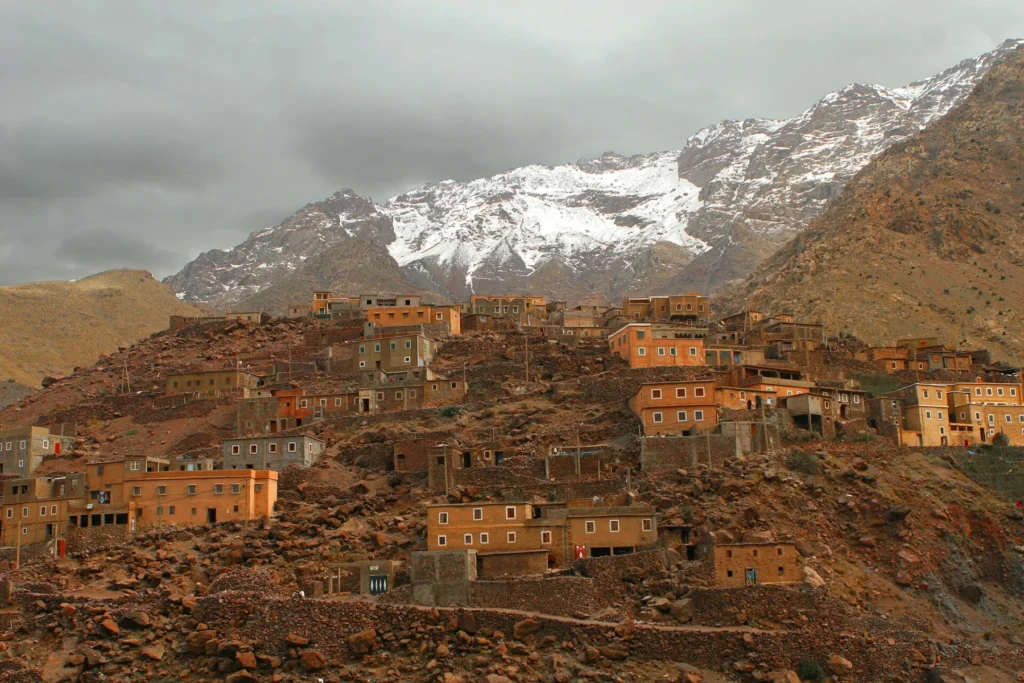
An hour and a half from Marrakech, the High Atlas changes the pace of a trip completely. Paths run between walnut trees and terraced barley fields, water channels follow the contours of the slopes, and villages of stone and earth houses climb the hillsides below snow-capped peaks for much of the year. Visiting the Berber villages in the High Atlas is one of the easiest ways to see rural Morocco from Marrakech, and one of the most rewarding, provided you go with realistic expectations and a little awareness of local customs. This guide covers the types of visit available, how hard the walking is, what to wear, when to go and how to be a considerate guest.
Amazigh, or Berber?
Most people living in the High Atlas are Amazigh, the indigenous people of North Africa, and many speak Tashelhit, an Amazigh language, as well as Moroccan Arabic. “Berber” is the term most visitors know and it is widely used in Morocco, including in tourism, but “Amazigh” (plural Imazighen) is the name many people use for themselves. Using it is a small sign of respect, and your guide will happily explain more.
It is also worth remembering that the High Atlas is not one place with one way of life. Some villages near Imlil see walkers every day and have guesthouses and cafés; others a few valleys away receive almost no visitors. Customs, architecture and daily routines vary from valley to valley, so treat what you see as one community’s way of life, not a picture of “the Berbers” as a whole.
What a village visit is really like
Most day visits from Marrakech centre on the valleys around Imlil, at roughly 1,700 metres, at the foot of Jbel Toubkal, North Africa’s highest peak at around 4,167 metres. The typical day is gentle: a walk of two or three hours on village paths, through orchards and fields, to a neighbouring village and back, often with mint tea in a family home along the way.
You will see working agriculture rather than a staged show. Terraces are irrigated by channels that share water between families, walnut and apple trees line the paths, and mules still carry loads where roads cannot go. Houses are often built of stone and earth, sometimes on top of one another up the slope, with flat roofs used for drying crops.
Some villages in the region were damaged by the earthquake of September 2023, and rebuilding continues in places. Visitors are welcome, and tourism is an important income for many families, but it is worth being sensitive to the fact that some households are still recovering.
Types of mountain excursion
| Type of visit | Time needed | Effort | Good for |
|---|---|---|---|
| Village walk near Imlil | Full day from Marrakech, 2–3 hours walking | Easy | First-time visitors, families, mixed fitness |
| Ourika Valley and Setti Fatma | Full day, short but rocky climb to the cascades | Easy to moderate | Rivers, waterfalls, a livelier valley |
| Oukaimeden plateau | Full day, walks at around 2,600 m | Easy, but cold | High-altitude views, rock engravings, snow in winter |
| Village-to-village trek | 2–3 days with nights in guesthouses | Moderate | Walkers who want to sleep in the mountains |
| Toubkal summit | Usually 2–3 days | Demanding | Fit hikers prepared for altitude |
Our Atlas Mountains and Imlil day trip is the village walk described above, with a local mountain guide. For a comparison of Imlil, the Ourika Valley and Oukaimeden as day trips, read which Atlas Mountains day trip to choose. If you would rather sleep in the mountains, the 3-day Atlas Mountains trek from Imlil goes from village to village with a mule carrying the luggage.
How hard is the walking?
On a standard village walk, the paths are unpaved, sometimes stony and occasionally steep for short stretches, but you do not need trekking experience. A reasonable level of everyday fitness is enough, and a good guide adjusts the route and pace to the group.
A few things make a difference:
- Altitude. At around 1,700 metres most people feel nothing more than slight breathlessness on climbs. Higher routes, and the Toubkal summit, are another matter and need proper preparation.
- Surface. Loose stones and dusty paths are more tiring than they look. Shoes with grip matter more than distance.
- Heat. In summer the sun is strong even when the air feels cooler than in Marrakech. Walk in the morning and carry water.
- Knees. Descents on uneven ground are harder on the knees than climbs. Walking poles help if you use them at home.
If anyone in your group has limited mobility, say so when you book. A shorter walk, or a visit focused on a single village, is always possible.
What to wear and bring
Mountain weather changes quickly, and it is always cooler than in Marrakech.
- Footwear: trainers with good grip or light walking shoes. Sandals are not suitable for most paths.
- Layers: a warm fleece or jumper outside summer, and a windproof or rain jacket from autumn to spring.
- Clothing: loose trousers or a long skirt and tops that cover the shoulders are practical for walking and respectful in villages.
- Sun protection: hat, sunglasses and sunscreen all year.
- Water and snacks: at least a litre of water per person; cafés are not always on the route.
- Cash: small notes for tea, a donation or a purchase from a cooperative.
When to go
- Spring (March to May): green fields, blossom in the orchards and snow on the peaks. Often the most beautiful season, though showers are possible.
- Summer (June to August): a welcome escape from the heat of Marrakech, but the midday sun is fierce. Start early.
- Autumn (September to November): warm days, harvest time in the orchards and clear views. Evenings turn cold by November.
- Winter (December to February): crisp, clear days and snow on the high ground. Paths can be icy or muddy, and some higher routes become difficult. Village walks usually remain possible with warm clothing.
Etiquette: being a good guest
Village life in the High Atlas is conservative and family-centred, and visitors are generally welcomed warmly. A few habits help that welcome go both ways.
- Greet people. “Salam alaykum” is understood everywhere; your guide can teach you a word or two of Tashelhit.
- Ask before taking photos of people, especially women and children, and accept a no gracefully. Landscapes and buildings are rarely a problem, but do not photograph inside homes unless invited to.
- Dress modestly in villages, with shoulders and knees covered. It is about respect rather than rules.
- Accept tea if you can. Being offered mint tea is a gesture of hospitality; a short visit is enough, and you do not need to drink every glass.
- Do not give sweets, pens or money to children. It encourages begging and can draw children away from school. If you want to help, buy from local cooperatives or ask your guide about community projects.
- Respect private land. Stay on paths, close gates, and do not pick fruit from orchards.
Questions to ask about transport and guides
Before you book, check:
- Is a local mountain guide included, or only a driver? On paths around villages a local guide makes the walk safer and far more interesting, and UK government travel advice recommends hiring a professional guide for walks in the mountains.
- How long is the walk, and can it be shortened?
- What happens in bad weather? Snow or heavy rain can close mountain roads and paths; a good provider has a plan B.
- Is lunch included, and where? On our Imlil day trip, the guide is included but lunch is paid locally.
Responsible travel in the mountains
- Carry your rubbish out, including plastic bottles. Waste collection is limited in many villages.
- Use water carefully. Mountain springs and irrigation channels are shared resources.
- Hire local. Guides, muleteers and guesthouses from the valleys keep tourism income in the community.
- Leave drones at home. Drones need prior authorisation in Morocco, and flying over villages is intrusive.
- Buy directly from cooperatives and village workshops rather than from roadside middlemen when you can.
Frequently asked questions
Can I visit a Berber village without a guide?
You can walk in the Imlil area independently, but a local guide makes visits to homes and villages far easier and more respectful, helps with the language, and knows the paths in bad weather.
Is it suitable for children?
Yes. A village walk near Imlil is one of the most family-friendly excursions from Marrakech. Plan a shorter route for young children and bring snacks.
Do we climb Mount Toubkal on a day trip?
No. The summit usually takes two to three days. Day trips walk in the valleys below the peak.
What is the best season for a village walk?
Spring and autumn are the most comfortable. Summer works with an early start; winter is beautiful but colder, with possible snow on higher paths.
Is it appropriate to give money in the villages?
Avoid giving to children. If you are welcomed into a home for tea, your guide can tell you whether a small contribution is customary for that family.
Planning your visit
If you would like to spend a day among the villages with a local mountain guide and your own driver, see our Atlas Mountains and Imlil day trip. For more time in the mountains, the 2-day Agafay Desert and Atlas Mountains tour combines an Imlil walk with a night in the desert.
Photo credits (Wikimedia Commons): Berber village Atlas by David Dennis, CC BY-SA 2.0.