
One day in Essaouira is very doable from Marrakech, as long as you know what you are signing up for. You will spend roughly six hours on the road in total and get four to five hours in town. That is enough to walk the sea ramparts, watch the fishing port at work, wander the medina and eat lunch by the harbour. It is not enough to add a lazy afternoon on the beach as well. This guide explains how the day usually unfolds, what is worth your limited time, and when an overnight stay makes more sense.
The journey from Marrakech
The road to Essaouira runs west across a wide, flat plain, and our drivers allow about three hours each way, including a stop. After the outskirts of Marrakech the scenery changes slowly: open farmland first, then the argan trees that grow almost nowhere else in the world. Most trips stop at a women’s cooperative where you can see argan nuts being cracked and pressed, and buy oil or cosmetics if you wish. There is no obligation to buy.
You may also see goats standing in the branches of argan trees along this road. Goats do climb argan trees to eat the fruit, but some of the roadside scenes are arranged for photographs, and the herders expect a tip if you stop. It is your choice whether to pull over.
Because the drive is long and mostly straight, it is a good time to rest. If anyone in your group is prone to car sickness, mention it before you set off so the driver can plan an extra stop.
How the day usually unfolds
| Part of the day | What happens |
|---|---|
| Morning | Pick-up at your hotel or riad in Marrakech, then the drive west with a stop at an argan cooperative |
| Late morning | Arrival in Essaouira; the port and the harbour bastion first, while the boats are busy |
| Midday | Lunch by the port or in the medina |
| Afternoon | The ramparts, the medina’s lanes and some free time |
| Late afternoon | Drive back to Marrakech, arriving in the evening |
Our Essaouira day trip lasts about ten hours door to door, with around four to five hours of free time in town. Exact times change with the season and with how long you want to stay.
The fishing port
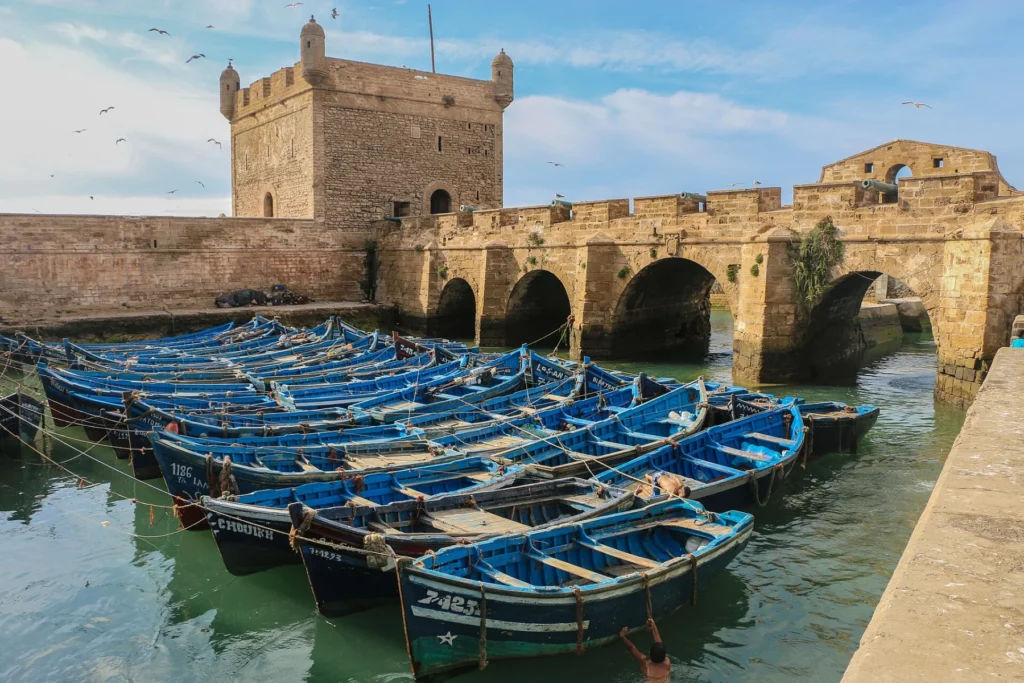
Start at the harbour, at the southern end of the medina. Rows of blue wooden boats are pulled up along the quays, nets are mended on the ground, and the catch is sorted and sold in the open. It is a working port, not a museum, so watch where you step and give people room to work.
Above the port stands the Sqala du Port, the harbour bastion with its arched sea gate. Climbing it gives one of the best views in town: the boats below, the medina’s white walls on one side, and the Île de Mogador across the bay.
Near the harbour entrance, small grill stalls cook fish and seafood to order. You usually choose your fish from a display and it is grilled while you wait. Agree the price, and whether it is by weight or per plate, before anything goes on the grill.
The ramparts
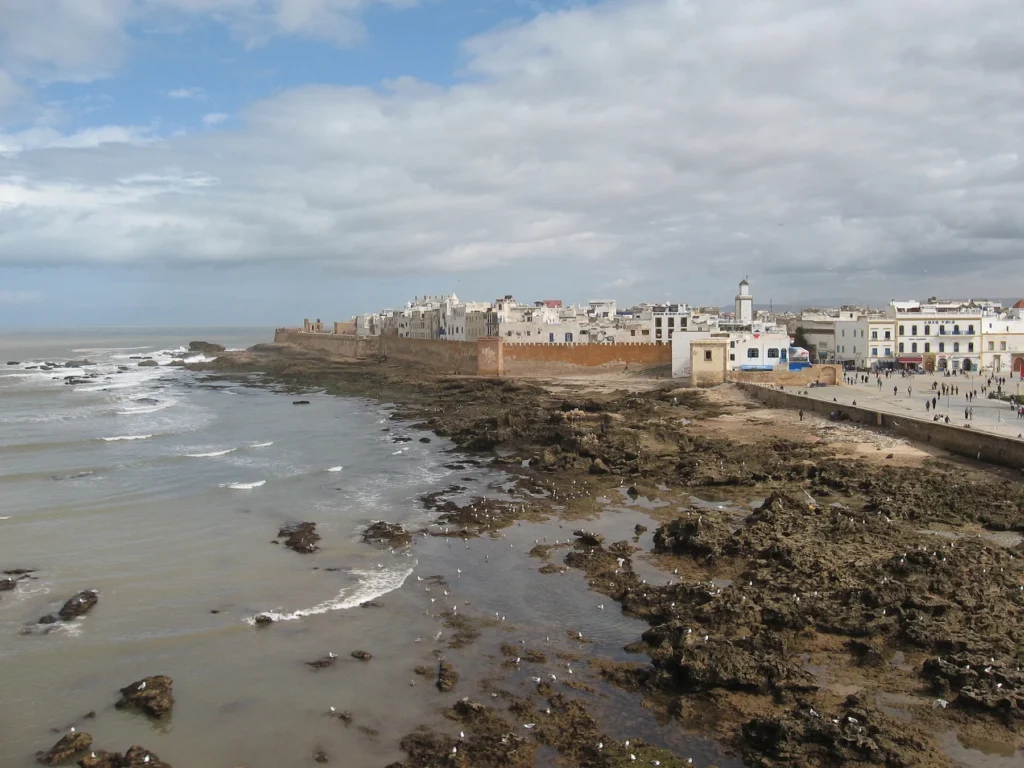
Essaouira was laid out in the 1760s on the orders of Sultan Mohammed ben Abdallah, partly by the French engineer Théodore Cornut, as a fortified port open to foreign trade. The sea walls are the most dramatic part of that plan. On the medina’s western edge, the Skala de la Ville is a long walled platform lined with old bronze cannons, where waves break against the rocks below. It is the spot most people picture when they think of Essaouira, and it is busiest in the late afternoon, when the light turns soft.
If the walls look familiar, the harbour’s fortifications appeared in the television series Game of Thrones as the city of Astapor.
The medina
The medina of Essaouira has been a UNESCO World Heritage Site since 2001. Because it was planned rather than grown over centuries, its main streets are straighter and easier to follow than in Marrakech, and the atmosphere is noticeably calmer. Whitewashed walls, blue shutters and arcaded streets give it a look quite different from the red city you have just left.
Worth seeking out:
- The main square, Place Moulay Hassan, between the port and the medina, lined with cafés and a good place to sit and watch the town.
- The woodworkers’ workshops near the ramparts, where craftsmen make boxes and furniture from thuya, a fragrant local wood often inlaid with lemonwood or mother-of-pearl.
- The Mellah, the historic Jewish quarter in the north of the medina, a reminder of the merchant community that once made Essaouira one of Morocco’s busiest trading ports.
- The spice and fish markets around the central crossroads, where daily life carries on alongside the craft shops.
Prices are generally lower and selling more relaxed than in Marrakech’s souks, but bargaining is still normal for crafts.
The beach and the coast
South of the medina, a wide sandy beach curves around the bay. Essaouira’s wind is part of its character: it keeps the town cooler than inland Morocco and makes the bay popular for windsurfing and kitesurfing, but it also means the beach is often better for a walk than for sunbathing. Sea conditions can be rough; swim only where it is clearly safe and follow any local flags or advice.
With a single day, most visitors walk part of the beach before heading back, rather than spending hours on it. If the beach is your priority, consider staying the night.
Food and local flavour
Seafood is the obvious choice: grilled sardines, sea bream, squid and prawns, either at the port stalls or in medina restaurants. Fish tagines are common on menus, and argan oil and amlou, a spread of argan oil, almonds and honey, appear at breakfast in many places.
Restaurants and cafés serve lunch throughout the early afternoon. Carry some cash in dirhams for small places, stalls and tips.
Weather and what to bring
Essaouira’s climate is mild all year, and the gap between day and night temperatures is small. On a hot summer day in Marrakech, the coast is often much cooler and breezier, which surprises many visitors. Pack:
- A light jacket or windproof layer, even in summer
- Sunglasses and sunscreen, as the sea breeze hides how strong the sun is
- Comfortable shoes for the cobbles and the ramparts
- A scarf, which helps on windy days
Our guide to what to wear in Morocco covers the rest of a typical trip.
Day trip or overnight stay?
A day trip suits you if you are based in Marrakech, have limited time and mainly want to see the port, the ramparts and the medina. Six hours of driving for four or five hours in town is a fair trade for many travellers, especially on a private trip where you choose the pace.
Stay at least one night if:
- You want to see the medina in the evening, when the day visitors have left
- You plan to spend time on the beach, surf or take a lesson
- You are travelling with young children who would find the round trip tiring
- Your visit coincides with the Gnaoua World Music Festival, usually held in the last week of June, when the town is at its liveliest and accommodation fills up early
You can also treat Essaouira as a stop on a longer route rather than a return trip from Marrakech. Tell us your plans and we can suggest how to fit it in.
Practical tips for the day
- Leave early in summer, so you arrive before the midday heat inland and have more time in town.
- A local guide in Essaouira is optional. The medina is easy to explore alone, but a guide adds context about its history and communities. On our trip, a guide is available on request.
- Keep valuables zipped away in busy areas, as you would in any popular town.
- Ask before photographing people, especially fishermen and stallholders at work.
Frequently asked questions
How long is the drive from Marrakech to Essaouira?
About three hours each way on our trips, including a short stop. Traffic and stops can change this.
Is one day enough for Essaouira?
For the port, the ramparts, the medina and lunch, yes. For the beach, water sports or the town’s evening atmosphere, stay at least one night.
Can you swim in Essaouira?
Sometimes, but the bay is often windy and the sea can be rough. Many visitors prefer to walk the beach. Swim only where it is clearly safe.
Do I need a guide in Essaouira?
No. The medina is compact and easy to navigate. A local guide is useful if you want to understand its history; we can arrange one on request.
When is the best time to visit Essaouira?
It can be visited all year. In summer it offers relief from the heat of Marrakech; in winter, days are usually mild but can be grey and windy.
Planning your day
If you would like a private day by the Atlantic with your own driver and pick-up from your riad, see our Essaouira day trip from Marrakech. For a wider comparison with the Atlas, the Agafay and Ouzoud, read the best day trips from Marrakech.
Photo credits (Wikimedia Commons): Essaouira Citadel by Ahmed.magdy, CC BY-SA 4.0; Ramparts of Essaouira by Kayaky, CC BY 3.0.