A night in a Sahara desert camp is the moment most travellers remember from their whole trip to Morocco. You ride into the dunes as the light turns gold, eat dinner by lantern light, sit under more stars than you have ever seen, and wake up early to watch the sun rise over the sand. This guide explains what a Sahara desert camp in Morocco is really like, from the tents and bathrooms to how cold it gets at night, so you know exactly what to expect.
How the evening unfolds
Most desert tours reach the edge of the dunes in the late afternoon. At Merzouga you usually leave your vehicle and ride a camel into the dunes towards camp, timing the ride for sunset. Luggage either goes ahead by 4×4 or you take a small overnight bag on the camel, so pack the essentials separately.
At camp, you are shown to your tent, offered mint tea and given time to climb a nearby dune for the last light. Dinner follows, often soup, a tagine and fruit, served in a dining tent or outside on mild nights. Afterwards, many camps light a fire and the staff play drums and sing. Then the generator or lights go quiet, and the stars take over.
Set an alarm for sunrise. Climbing a dune in the cool, blue dawn and watching the first light hit the sand is worth the early start. After breakfast, you ride or drive back to the edge of the dunes and continue your journey.
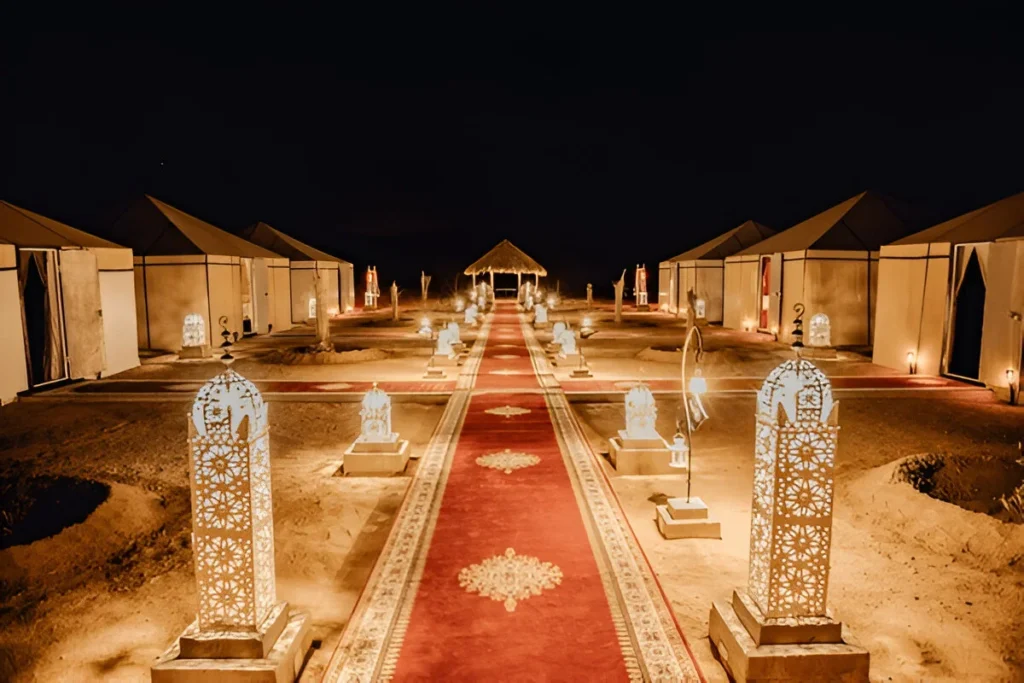
What are the tents like?
Desert camps come in two broad types, and the difference matters more than anything else in your night.
| Standard camp | Luxury camp | |
|---|---|---|
| Tent | Simple tent with beds and blankets | Large tent with a proper bed, furniture and rugs |
| Bathroom | Usually shared toilets and showers | Private bathroom inside or attached to the tent |
| Electricity | Limited, sometimes only in communal areas | Lighting and sockets in the tent, often solar |
| Best for | Budget travellers and those who want simplicity | Couples, families and anyone who values comfort |
Ask before you book which type is included. On our desert tours, standard tents are included and upgraded or luxury tents are available on request.
Does the Sahara get cold at night?
Yes, often more than people expect. The desert loses heat quickly after sunset. In Merzouga, average lows are around 7°C in December and around 4°C in January, and it can feel colder in the open dunes with a breeze. In summer, nights are warm and days are very hot.
Camps provide thick blankets in the cooler months, but pack warm layers between November and March: a fleece or down jacket, a hat and warm socks for the evening and sunrise. In summer, the challenge is the daytime heat, so drink plenty of water and avoid long walks in the middle of the day.
Is it safe to sleep in the Sahara in Morocco?
Established camps near Merzouga and Zagora host visitors every night of the year and are staffed around the clock. The main practical risks are simple ones: dehydration, sunburn and twisted ankles on the dunes in the dark. Bring a torch or use your phone light, stay close to camp at night and follow your guide’s advice.
For the wider picture, check your government’s travel advice before you go. The US State Department, for example, currently lists Morocco at Level 2, “exercise increased caution”, across the whole country (see the latest advisory).
Toilets, showers and phone signal
- Toilets: many camps now have flushing toilets, shared in standard camps and private in luxury ones. Ask if this matters to you.
- Showers: available at most camps, though water may be limited. Many travellers simply shower at the hotel the night before or after.
- Charging: power may be limited. Bring a charged power bank.
- Phone signal: it can be weak or patchy among the dunes. Let family know you may be offline for the night.
What to pack for one night in the desert
- A small overnight bag for the camel ride
- Warm layers for the evening and sunrise, even in spring and autumn
- Sunglasses, sunscreen and a scarf to protect your face from sun and wind-blown sand
- Comfortable shoes you can empty of sand, or sandals for the dunes
- A torch or headlamp and a power bank
- Any medication, and tissues or wet wipes
For a fuller list by season, see what to wear in Morocco.
Frequently asked questions
Can you camp in the desert in Morocco?
Yes. Organised desert camps operate near Merzouga (Erg Chebbi), Zagora and Erg Chigaga, and most desert tours from Marrakech include one night in a camp.
How cold is the Sahara at night in Morocco?
In winter, nights in Merzouga average around 4 to 7°C and can feel close to freezing in the open. Summer nights are warm.
Do desert camps have bathrooms?
Yes. Standard camps usually have shared toilets and showers; luxury camps have private bathrooms.
Is one night in the desert enough?
For most travellers, yes. One night gives you sunset, the evening at camp and sunrise. A second night only makes sense if you want a slower pace or a longer camel trek.
The bottom line
A Sahara camp is simple, beautiful and more comfortable than many people expect, as long as you pack for a cold night in winter and choose the tent type that suits you. To experience it, join our 3-day Merzouga desert tour, take the slower 4-day Merzouga and Draa Valley tour, or compare all our Sahara desert tours.